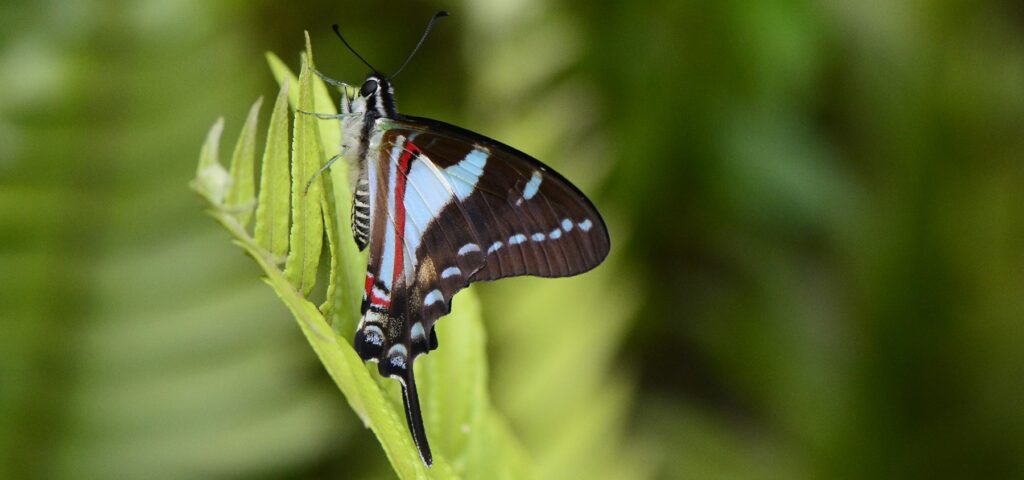
Two species of Swallowtail endemic to Jamaica: The Jamaican Giant Swallowtail or Homerus Swallowtail (Pterourus homerus) and the Blue Kite Swallowtail (Protographium marcellinus) are both in need of additional protection. Two recent papers published in May 2025 in Tropical Lepidoptera Research by Thomas Turner and Vaughan Turland have highlighted the continued threats to these two stunning butterflies found only in Jamaica.
The Jamaican Giant Swallowtail or Homerus Swallowtail (Pterourus homerus)
The paper on Homerus Swallowtail describes the two remaining sub-populations of the Homerus Swallowtail in the Cockpit Country to the western centre of the island and the John Crow Mountains on the eastern side of the island. Suitable habitat for Homerus Swallowtail is estimated to be less than 8% of the total landmass of Jamaica. The threat of bauxite mining and the continued removal or thinning of the forests in and around the areas containing the sub populations remain a threat. The paper highlights the real need for immediate action to preserve the remaining habitats without any further fragmentation, reduction in size or degradation through any form of human encroachment.
The paper describes the historical aspects for Homerus Swallowtail in some detail including population studies in both sub-populations as well as the availability of the larval foodplants and nectar sources all so critical to the survival of this stunning butterfly.
The paper ends with a number of strategies for the conservation of Homerus Swallowtail.
The authors propose that Homerus Swallowtail is now assessed as being Critically Endangered based on the criteria from IUCN based on population size.
The Homerus Swallowtail is a CITES Appendix I species, a species threatened with extinction. Trade in specimens of this species is permitted only in exceptional circumstances.
Blue Kite Swallowtail (Protographium marcellinus)
The lifecycle of the Blue Kite Swallowtail is described for the first time in this paper, including the migratory behaviour of this butterfly.
There are four small breeding sites documented which now occupy between 0.3km2 and 1.5km2 in each area. A total area of just 2.5km2 in total. The paper describes the present threats of destruction of the only known larval foodplant at each of these sites. The authors provide supporting evidence for the need to provide additional protection for this butterfly.
A review of the four current isolated breeding sites and the threats to those sites is covered in detail. The main threats to the survival of this butterfly is the loss of its only known larval foodplant Lancewood (Oxandra lanceolata) a species of plant in the Annonaceae family. The plant can grow up to 5m in height but it is often only found now as saplings. These saplings are in very high demand locally and are cut in their thousands each year for use as sticks for yam cultivation. This practice of sapling removal for this duty is a major contributor to the deforestation of Jamaica. Unfortunately, a high density of Lancewood appears to be a prerequisite for the breeding sites of the Blue Kite Swallowtail.
The authors argue for enhanced protection of the current breeding sites which includes the planting of more Oxandra to restore or improve the habitat.
The Blue Kite Swallowtail is protected under the Jamaican Wild Life Protection Act (1945) and fines of up to J$100,000 ($620 USD) per specimen or one year in prison can be levied for any life stage of this butterfly.
The authors propose that the Blue Kite Swallowtail is now assessed as being Critically Endangered based on all the information to hand.
Since this article was first written Jamaica has been hit by Hurricane Melissa one of the most powerful hurricanes to ever hit Jamaica.
In a note from Tom Turner sent just after the hurricane he writes “The Cockpit Country habitat for critically endangered P. homerus, P. marcellinus and Atlantea pantoni was hit very hard. Trees have been stripped but new growth will appear in just a few weeks. It is then that any surviving pupae will begin restocking their battered populations. They have had to do this before and will undoubtedly rebound again but I am not sure of the timeline.”


