SBBT

Saving swallowtail and birdwing butterflies

Donate

  • Bluesky
  • E-mail
  • Facebook
  • Instagram
  • Twitter
  • YouTube
  • Home
  • Latest News & Blogs
    • News
    • Blog
  • About Us
    • In Brief
    • People
      • Patron, President & Board Of Trustees
      • Honorary Advisors & Coordinators
    • Frequently Asked Questions
    • Opportunities
      • Position vacant: Hon. Secretary
      • Position Vacant: Trustee
    • Small Print
      • Constitution of the Swallowtail and Birdwing Butterfly Trust
      • Charity Registration
      • Privacy Policy
      • Annual Reports & Financials
  • Our Projects
    • Conservation
      • Conservation of the Swallowtail in Britain
        • Wheatfen Meeting Agenda and Speakers 27 June 2018
        • Meeting Report: Conservation of the Swallowtail in Britain
        • Swallowtail MSC Studentships
        • Report in the Guardian
      • Queen Alexandra’s Birdwing Project
      • The Bhutan Glories and Shoskom – the Bhutan Glories’ Hill
      • Swallowtail Survey on Fiji Identifies New Species
        • SBBT’s Further Studies on the Natewa Swallowtail
      • Swallowtail Survey on Dominica
      • Homerus Swallowtail DNA Study
      • Kinabalu or Borneo Birdwing
        • Kinabalu Birdwing Project Update 2023
        • Kinabalu Birdwing Project
      • Richmond Birdwing
    • Research Needs
    • On-line Conferences
      • “Saving Swallowtails: the Apollos and their Allies” 2024
      • “Saving Swallowtails” 2021
        • “SAVING SWALLOWTAILS” CONFERENCE WORLD SWALLOWTAIL DAY 2021 REPORT
    • World Swallowtail Day
      • 2024 World Swallowtail Day – 9th June
      • 2023 World Swallowtail Day – 11th June
      • Saving Swallowtails – 12 June 2021
      • 2020 World Swallowtail Day – 14th June
        • SBBT Photography Competition Winners
        • Swallowtail Limerick Day
        • Colouring Book
      • 2019 World Swallowtail Day – REPORT
  • About Swallowtails
    • Swallowtails of the World
      • Papilionidae – Global List (Test)
      • Swallowtails of the World – Take the Tour
      • Subfamily Baroniinae
      • Subfamily Papilioninae
      • Subfamily Parnassiinae
      • References
      • Featured Species
        • Macleay’s Swallowtail
        • Richmond Birdwing
        • Small Réunion Swallowtail: Papilio phorbanta
    • Biology
    • Distribution & Classification
    • Swallowtails & Humankind
    • Swallowtails & Science
    • Threats To Swallowtails
      • Top Ten Threatened Species
        • Graphium levassori
        • Graphium sandawanum
        • Ceylon Rose: Atrophaneura jophon
        • Southern Tailed Birdwing: Ornithoptera meridionalis
        • Queen Alexandra’s Birdwing
        • Wallace’s Golden Birdwing: Ornithoptera croesus
        • Homer’s or Homerus Swallowtail: Papilio homerus
        • Papilio moerneri
        • Papilio aristophontes
        • Luzon Peacock Swallowtail: Papilio chikae
    • Captive Breeding & Release Of Butterflies
    • Key References
  • Publications
    • Papilio! Newsletters
    • Global Priorities
    • Action Plan
  • Artwork
  • Merchandise
  • Contact Us
  • World Swallowtail Day – 8th June 2025
SBBT » Latest News and Blog » Blog » Apollo Butterflies of Nepal

Apollo Butterflies of Nepal

12th December 2025 by Martin Partridge

In Nepal the increase in elevation from 62 meters to 8,848 meters represents a gradual transition in altitude from south to north, showcasing diverse and dynamic ecosystems within this country, which hosts a range of habitats that support butterflies of different conservation status.

A few species of high mountain butterflies, such as various species of Apollo, can be seen as high as 5,300 meters in Nepal’s Himalayas (Smith,1989). These insects are highly adapted to thrive in frigid environment and can be seen soaring in the elevated terraces where scanty and short vegetation is present.
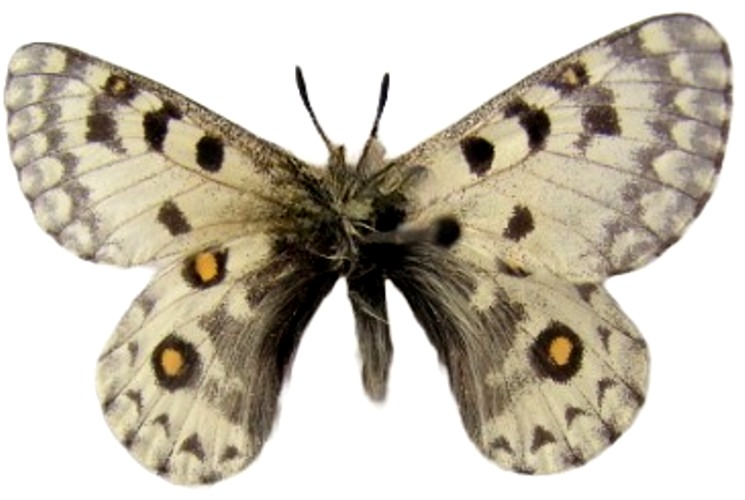
Common Red Apollo (Parnassius epaphus)
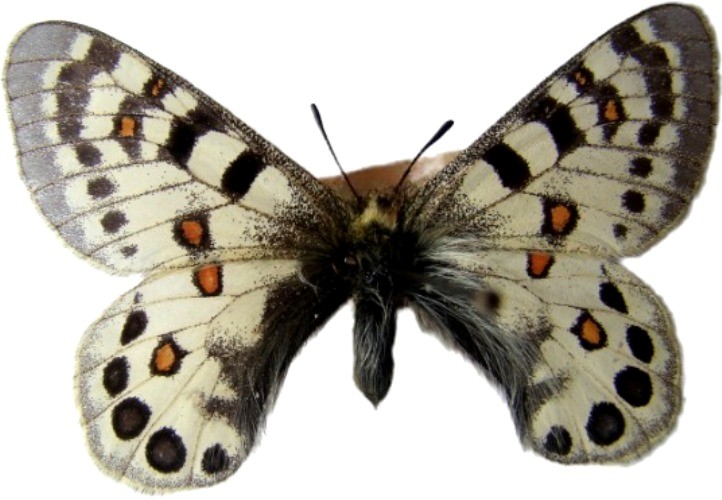
Common Blue Apollo (Parnassius hardwickii)

Apollo (Parnassius) butterflies represent a distinctive feature of the Himalayan region. Apollo butterflies are typically observed from mid-May until the end of September, whereas Common Blue Apollo (P. hardwickii) can be found year-round, with the exception of the coldest months of January and February (Smith, 1989). Among Nepal’s Apollos, the Common Red Apollo is observed at the altitudes ranging from 3,500 to 5,454 meters (Nepali and Khanal,1983). The dark patterns on their wings and slightly darker bodies serve to absorb solar heat, enabling them to thrive in colder environments. Additionally, they possess dark, hairy abdomens that help to retain their body heat.

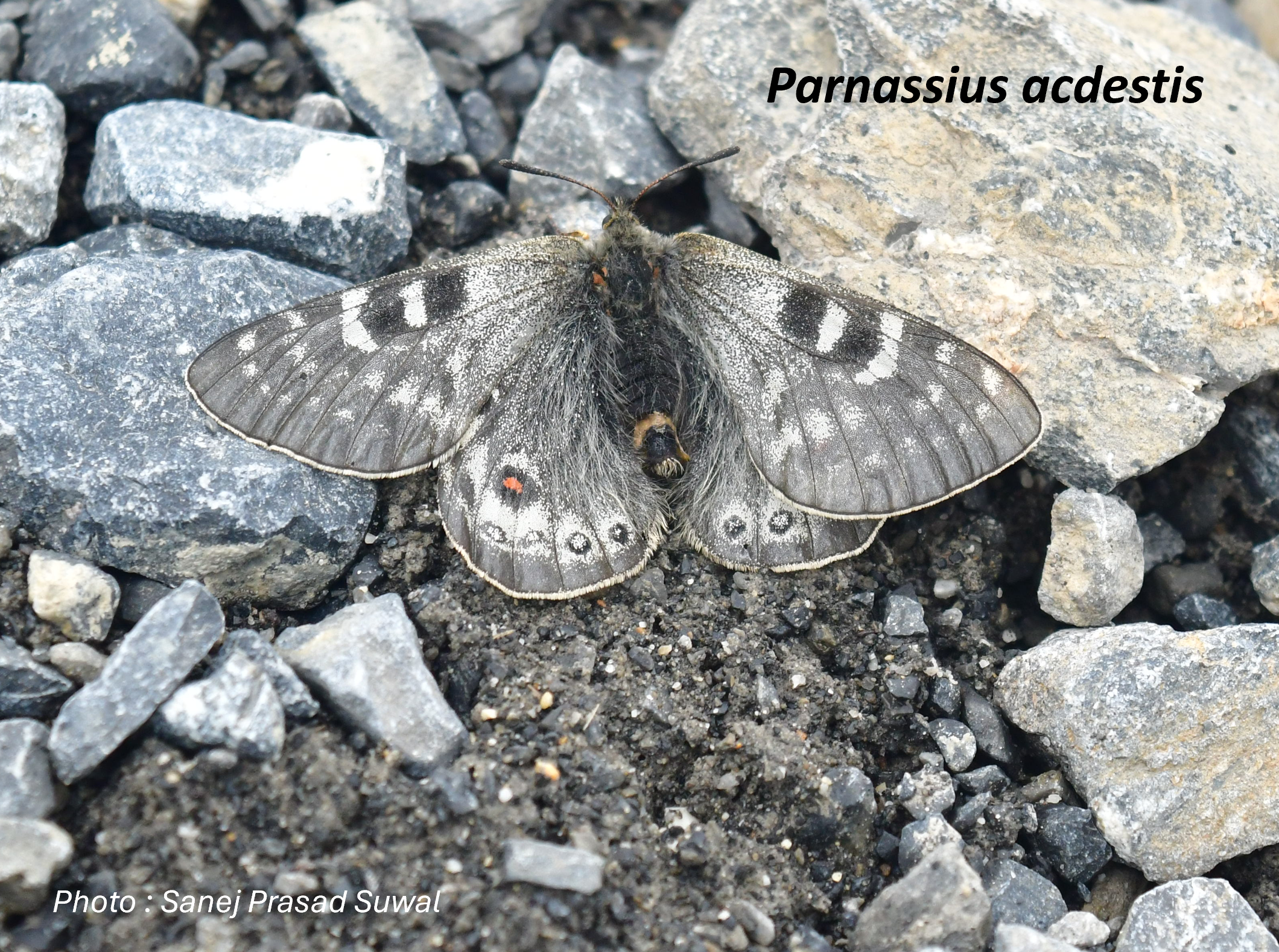
One notable rare species of Parnassius found in Nepal is the Sikkim Banded Apollo (Parnassius acdestis), which is confined to limited areas of the western Nepal within the elevations of 4,698 m to 5,245 m. Its three endemic subspecies (markii, laurentii and whitei) were documented by Epstein (1979) from Manang and Dolpo of west Nepal.


Sikkim Banded Apollo (P. acdestis laurentii)

Apollo habitat in the Upper Temperate Zone of the Himalayas in Nepal

References 

Epstein, H. J. (1979). Interesting, rare and new Papilionids (Lepidoptera: Papilionidae) from the central Nepal Himalayas. International Nepal Himalaya Expedition for Lepidoptera Palearctic –INHELP,. Entomologist’s Gazette 30(3):15

Inomata, T. (1998). Parnasiinae from Nepal. Moths of Nepal Haruta (Ed.), – Part 5. Shinjuku, Tokyo: Tinea, Japan Heterocerists’ Society. [including Parnassius species]:314 pp., 31 pl.

Nepali, H. S. & Khanal, B. (1983). Some Trans Himalayan Butterflies from Dolpo and Manang regions of Nepal. Journal of Natural History Museum 7:35–40.

Oshima, S-I. (1985). A New Subspecies of Parnassius cephalus (Grum-Grshimailo, 1891) from Nepal Himalaya (Lepidoptera, Papilionidae), Toy to Ga 36 (2):77– 82.

Smith, C. (1989). Butterflies of Nepal. Tecpress Services, Bangkok, Thailand.

Author:

Dr. Bhaiya Khanal

Professor, Natural History Museum (Tribhuvan University), Kathmandu, Nepal

Email: baya2000@live.com

Filed Under: Blog Tagged With: Apollo, Nepal, Parnassius

Newsletter


    We want to keep you up to date!
    Sign up to hear from us and we’ll send you our free e-newsletter and keep you up to date with what’s happening at the Swallowtail & Birdwing Butterfly Trust, including news, campaigns and appeals. Don't worry, we take care of your data and never release it to third parties. See our Privacy Policy for details

    Latest News

    Apollo Butterflies of Nepal

    12th December 2025

    Featured species : Kaiser-I-Hind

    29th August 2025

    The Bhutan Glories: An update from Sonam Dorji

    29th May 2025

    Featured species: Papilio hornimani

    27th May 2025

    Thank you to outgoing chairman N. Mark Collins

    21st May 2025

    Useful Links

    • Contact Us
    • Donate
    • Latest News and Blog

    Supporters & Collaborators

    Our Mission

    The mission of the Swallowtail and Birdwing Butterfly Trust is to conserve and protect members of the Papilionidae, a worldwide family of more than 580 species that include the largest, most spectacular and most endangered butterflies on the planet.
     

    Aims

    SBBT aims to build the capacity of local people and organisations to achieve long-lasting conservation and sustainable change.

    Methods

    We achieve this in four ways: we raise financial resources; convene research networks and partnerships; catalyse action, and provide scientific and technical support to conservation projects.

    Wider Reach

    Our work is generally planned and executed in the context of wider butterfly faunas, their foodplants, and the ecosystems that they inhabit.

    Giving

    Financial contributions are welcome and will be treasured. We also need your ideas, new information, suggestions and encouragement!

    Donate Today

    What We Do

    We do four things to help swallowtails and birdwings: we raise financial resources; convene networks and partnerships; catalyse action, and provide scientific and technical support.

    Contact Us

    Send an email to info@sbbt.org.uk, or post a letter to SBBT, c/o Stephenson Smart, Queens Head House, The Street, Acle, Norwich NR13 3DY, UK

    Connect

    • Bluesky
    • E-mail
    • Facebook
    • Instagram
    • Twitter
    • YouTube

    Useful Links

    • Home
    • About Swallowtails
    • About us
    • Our projects
    • Publications
    • Donate
    • Contact us

    Papilio! Newsletter


      We want to keep you up to date!
      Sign up to hear from us and we’ll send you our free e-newsletter and keep you up to date with what’s happening at the Swallowtail & Birdwing Butterfly Trust, including news, campaigns and appeals. Don't worry, we take care of your data and never release it to third parties. See our Privacy Policy for details

      © Copyright SBBT 2025 All Rights Reserved · Registered Charity 1174142